PyOhio 2026 recap
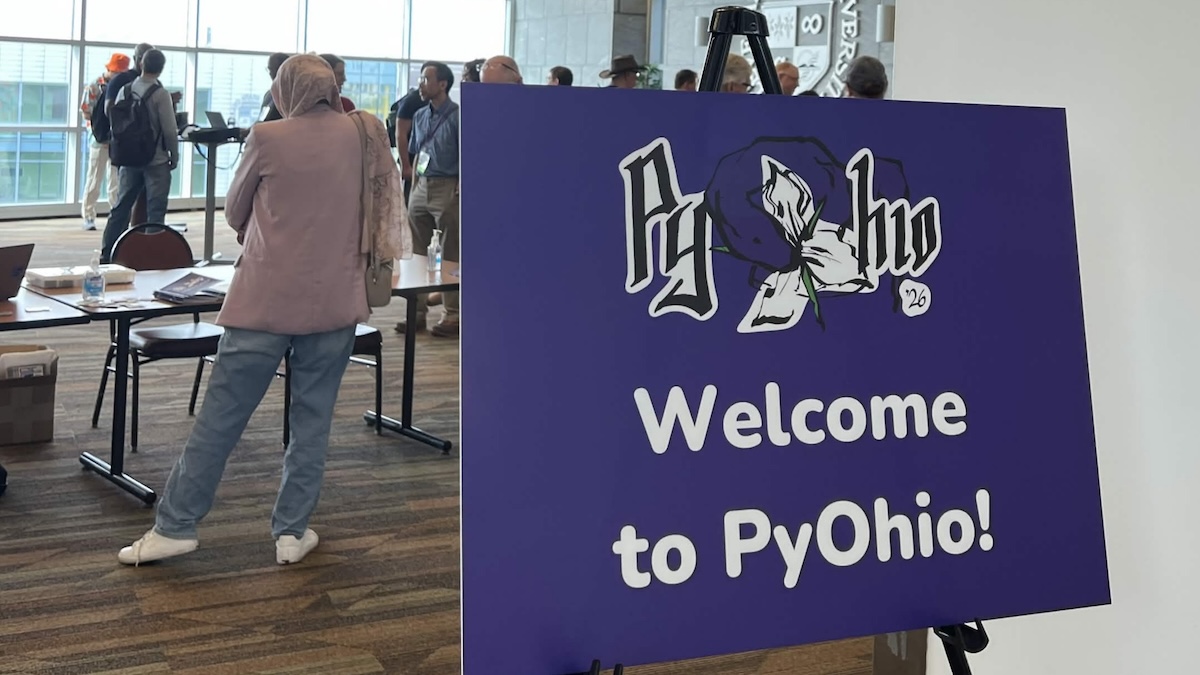
I had a wonderful time at PyOhio this year and hope to attend more in the future. It was well-organized, welcoming, and educational—everything an attendee may be looking for in an event.
General thoughts
I was excited for this event because I had two presentations, I was going to be able to attend all the BPD Leadership Summit1, and Kattni was the conference chair. Admittedly, my presentations led to a lot of stress on my part. Emily pointed out for the N-th time that I get squirrely when I have a talk2. Though I suspect taking a red-eye flight from Portland to Chicago, then driving 2.5 hours at 4:30am two days before the conference, had a big impact.
I was excited to be attending a conference that Kattni chaired for a few reasons. First, she’s absolutely remarkable. I’ve enjoyed all of our conversations, from those in conferencechats.org events to hanging out at DjangoCon US to working together for Djangonaut Space. In each interaction, there’s a lot of consideration, intelligence, and humor, but it’s never been in a venue where I’ve felt like she’s strongly curating it. There’s something about stepping into a friend’s space and getting to know them on a different level. I’m curious if others have felt the same…
My networking challenge
With all that, I still had some challenges this conference. My goals were generally set, but perhaps a little fuzzy, and in that fuzziness, I made a few small missteps. With my business, I’m there to find clients, plain and simple. But! And as I quickly remembered in Cleveland, people tend not to like to be sold in a direct manner. So when I was asked, “What do you do?” responding with “I provide 1:1 mentoring for people who want to be better Django and software engineers,” I could see the walls go up. Rightfully so.
When they hear that, there’s the implication that I have a financial interest in developing the relationship. At the same time, they are unaware of who I am, what I do (both professionally and for the community), and where we may have other overlapping interests. That disparity immediately throws the conversation off-balance and creates uncomfortableness. And while I am there to find a client, I’m also there as a community member who wants to help connect folks. Having a less bold response to that question should allow the conversation to build more comfortably and lead to a better connection.
The other bit of networking that I struggled with is that I didn’t realize how much I utilized communal meals as a way to make new connections. Specifically, at PyCon US and DjangoCon US, lunches are provided where a person can sit at any table. This makes it super easy for me to meet some new folks for 30-45 minutes and then move on. With PyOhio, folks self-organized lunches at local restaurants. Logistically, it works well, but I found that I was unprepared to utilize that time for networking. In the future, I’ll want to be better prepared to set up a lunch with someone new. I suspect putting a message, well before lunch, on the lets-get-food channel with the stated goal of meeting new people may be an easy solve here. Crap. That seems really obvious now in hindsight.
I do want to clarify that this is me wanting to be better at networking. It’s not as if I did a poor job of it at this conference or that the conference was incompatible. If I was rating out of 5 stars, I’d give my efforts 4. But considering the expense and opportunity, there’s a strong desire to be as good as possible in this area. If you’re looking at this as criticism, it’s really criticism meant to go from great to perfection rather than criticism to go from bad to good. I hope that makes sense.
Black Python Devs Leadership Summit
The BPD Leadership Summit was a nice lead-in to the conference. The talks we had were insightful and reassuring. When registering, attendees were asked to put down what they were hoping to get out of the summit. To be honest, my first thought was, “I just knew I should be in the room.” But with a bit of contemplation, I realized one of my primary motivators was to learn how to better grow leaders and cultivate contributors/maintainers. After I added it to the list, a friend said, “Isn’t that your expertise?” referring to my involvement with Djangonaut Space. And while that is true, it’s not something I feel totally confident about. There’s so much variability, and at times, I feel like we’ve lucked into a working path. Others likely have their own experiences about what works, and that’s what I wanted to find out.
Some of my highlights from the event were:
- Bonny McClain’s point of perspective and perception and how they can be adjusted to change a story to be more compelling.
- Joy Hopkins’ discussion on leading from the middle, especially from the perspective of fragmented open-source communities.
- Jon Banafato’s continuation on his stacking chairs metaphor with his suggestion to view tasks as opportunities for others to join in.
- Lazouich Ford’s personal story of supporting BPD and my realization that I should look for the opinionated people who are showing up and empower them.
- Kattni’s talk gave me several ideas on how to grow Django’s community: hosting community check-ins, posting the DSF office hours to the Discord server, and regularly recognizing contributors in meetings.
- During the chop it up session, I deeply appreciated Jay Miller having the people who were most active for the first portion of the discussion remain silent for the last portion to give space for others.
Saturday
The keynotes on Saturday were wonderful. I connected with Dr. Juliana Novac’s points on how to facilitate inclusion. I’m hoping to reach out to some past community members who I haven’t seen in a while to reconnect with them. It feels like a good way to keep the community connected and moving forward.
Carol Willing’s talk was just outstanding! Following her journey through the community and seeing how others have supported her was incredibly insightful. It was cool to see how the Django community got so many callouts during her talk, especially given that it was on a topic that we pride ourselves on. I also need to go buy the book she recommended, “The Psychology of Software Teams”3.
The rest of the day I spent at community talks, of which I attended the following talks:
- What If Voyager Launched in 2026 — and Ran Python? by Cliff Jenkins, which was a fun talk exploring how Python can be used in resource-constrained situations. It was well presented and a fun talk to attend. I don’t know much about that world of Python, but it looks like it’s in good shape!
- “Oh, You’re Right” Is Not a Review: Orchestrating Agentic AI That Proves What It Checked by Calvin Hendrix-Parker, which was an insightful talk on how to make agents more deterministic. He covered several topics that I’m very inexperienced on, so I was appreciative to learn from him. This is a talk I’ll want to refer to in the future.
- In Defense of Thoughtful Testing: Rethinking Quality in the Age of AI-Generated Code, which was an insightful talk on how to approach integrating AI-generated code. It touched on several ideas that I found myself agreeing with.
10 Django Features Talk
The first of the talks I was involved with was my “10 Dazzling, Joyful, Astounding, Nifty, Glorious, Outstanding Features in Django” talk, in which I covered 10 nifty features of Django. I thought it went well. There were a few minor bumps, but I was able to cover all the features in a way that I wanted to. My stretch goal of having the audience participate by voting on which of my cats they got to see a photo of worked fairly well too. I walked away from the talk feeling pretty great, which counts for a lot.
That said, if you were in the room and have feedback, good or bad, I would be interested in hearing it!
Djangonaut Space Talk
The second talk was with Rachell Calhoun about Djangonaut Space, “Djangonaut Space: Mentoring Contributors, Empowering Leaders”. This talk was a slimmed-down version of our PyCon US keynote, with a panel attached at the end. We brought Kattni and Eric Matthes up to the stage to answer several questions about their experience as first-time navigators during session 6. Since we removed the heart of the keynote and kept the structural information, having Kattni and Eric share their experience was beautiful. The insights and passion they shared were spectacular to me. I hope future folks find themselves interested in volunteering or participating in a future session.
Sunday
Sunday’s program schedule has a late start, which honestly was beneficial to me. I tend to be a person who stays up with whoever else is willing to, making sleep Future Tim’s problem. With talks not starting until noon, I was able to squeeze an hour or two more sleep than I normally would. That morning started out with an insightful breakfast with several friends, all of whom had astonishing life experiences to share. With 3 of the 5 attendees being prolific authors, the discussion was surprisingly more about writing than programming.
The closing keynote was delivered by Christopher Neugebauer and dove into statistics and how they are relevant with AI usage. I enjoyed the way Chris wove his talk together, especially the point on how AI literally can’t help with novel problems as it lacks context. I heard from several people during the conference that they are frustrated with the hype of AI because it muddies the water. Furthermore, I saw Chris’ talk as a source of clarity to look at the tool for what it is, where it helps, and where it’s going to fall short.
Chris also quoted a line from a blog post of mine from earlier this year, which was pretty damn cool. I haven’t had that happen before, and it’s still a mental exercise for me to understand that I’m not simply shouting into the void (all the time). Seeing and hearing Chris mention me on stage was one of those moments where it’s a clear signal that I have indeed been moving forwards. So thank you, Chris!
Before the closing keynote were community talks, of which I attended the following:
- Beyond Vibe Coding: A Spec-Driven AI Workflow for Serious Development by Benjamin Patch, which was an informative talk on how to maximize effective output from LLMs. This, in general, was insightful on how to use LLMs in a more process-oriented way, but I really appreciated his breakdown on when to switch models for categories of tasks. That was neat.
- Speeding Up Clinical Trial Analysis with Python by James Austrow, which was a dive into using an efficient algorithm to solve a statistical test. Admittedly, the first part of this talk went well over my head, but when we got to the algorithm discussion and Python, I found my footing and was intrigued by James’ work.
- Testing the Parts You Don’t See: Pseudo-Tested Native Code in Python Libraries by Issei Hasegawa, which discussed their new library, PseudoScope. Issei covers the idea that just because you have test coverage doesn’t mean the tests are actually valuable. Yes, the code doesn’t raise an exception, but are your tests validating that the code works properly? To solve this, Issei’s library swaps out the body of your function based on the signature and re-runs the test suite. It’s a fantastic idea, and I look forward to seeing it develop further.
Last thoughts
I want to reiterate that this was a wonderful conference. The organizers should be super proud of their work! It was an experience that made me intend to attend again in the future. To the organizers, volunteers, speakers, and everyone who attended, thank you for making my experience so wonderful!
If we met (or didn’t) and you’d like to chat, please let me know. You can find me on the Fediverse, Django Discord server or via email.
Written by Tim Schilling
Django 6.x Steering Council member, maintainer of django-debug-toolbar and django-simple-history, and a professional software engineer since 2009. These days, I mentor developers one-on-one.